Health systems evaluating AI denial prevention need confidence that their investment will actually reduce denials. Granularly, this means that there has to be a clear connection between AI model output and workflow action.
The Model Is Not the Product
AI models in revenue cycle are getting genuinely good at prediction. With enough historical payments data (835/837 data, payer behavior patterns, DRG-level denial trends), a well-trained model can score denial probability pre-bill. But predictions (or scores) that sit outside a workflow are just information. It doesn’t change behavior and it doesn’t prevent denial.
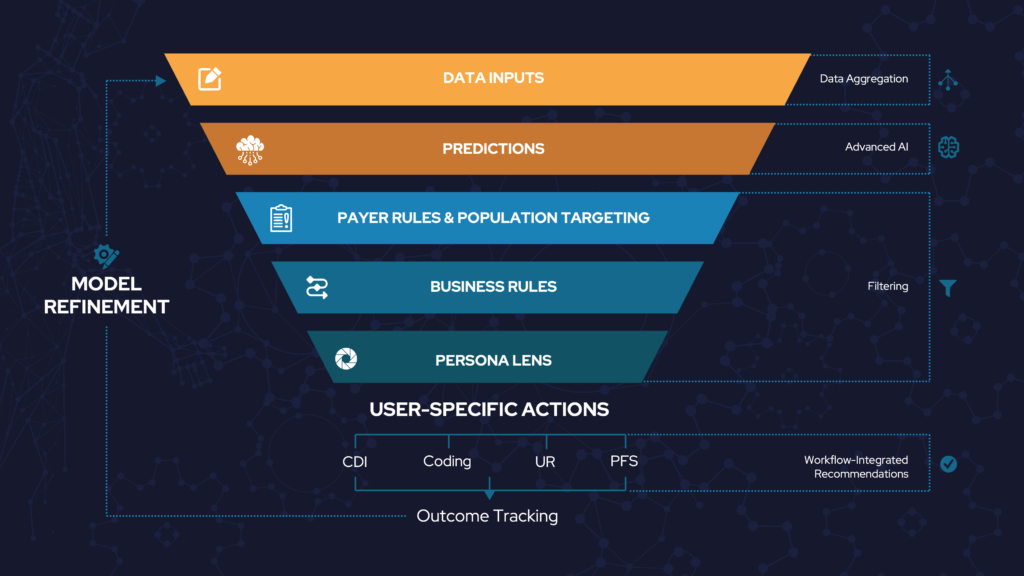
What converts an AI output into a denial prevented or a dollar recovered is a translation layer. An intelligence infrastructure that takes a model’s output and routes it with an actionable recommendation into the right workqueue, at the right time, in a format the specific user can actually carry out.
This is harder to build than the AI model itself, and it’s where most point solutions fall short.
What “Actionable” Actually Requires
For AI denial prevention to work, there are three requirements most revenue cycle vendors underestimate:
- Combined clinical and financial data. Denial risk doesn’t live in the 837 alone. Root cause, whether it’s a DRG-level authorization gap, a payer-specific COB pattern, or a service line with a documentation problem, requires connecting clinical context to payment outcomes. Without that connection, the model is pattern-matching on incomplete information.
- Direct integration into existing workflows. Revenue cycle teams don’t want to open a separate dashboard. The prevention recommendations have to live inside the workflows they’re already in. For most large health systems, that means EHR integration, scoring embedded at the account level and with prioritization logic the team can actually trust (which ironically, is hard to find in EHR-native denials scoring).
- An intelligence layer that explains the score. An AI denial prevention or prioritization score without context asks staff to trust a black box. When the model output is paired with root cause analysis, users understand why an account is high-risk and what intervention can address it.
What This Looks Like in Practice
One large health system we work with scored over 150,000 denied claims in a single fiscal year, analyzing 500+ attributes per claim to produce a prioritized denials workqueue inside Epic. The result wasn’t just that high-yield accounts got worked first; it was that the team stopped guessing. In the months where they leaned hardest into the scoring, their denial overturn recovery rate improved 54% compared to the prior period. Roughly 75% of incremental recovery dollars came from the top 16% of scored accounts. The bottom half of the queue (accounts that Sift’s models scored lowest) accounted for less than 5% of recovered dollars.
That distribution reflects something consistent across denial populations. Recoverable value is concentrated, and legacy (or rules-based) prioritization logic can’t see it.
Denial Prevention Requires the Same Infrastructure
Recovery is the more visible use case, but the same intelligence infrastructure is what makes AI denial prevention work in pre-bill. When you can see denial risk by payer, DRG, and clinical context before a claim goes out, and route that risk signal to the right person to act on it, you’re not just recovering more. You’re breaking the cycle that creates the denials in the first place.
AI denial prevention is extremely valuable to hospitals when the intelligence doesn’t stop at the model output. Sift’s RevProtect platform is built on this premise — payment intelligence only creates value when it’s connected end-to-end, from clinical data to final payment outcome. Contact us if you want to see what that looks like against your specific payer mix and denial population.