
Every health system has a number it never sees. It’s the distance between what you could collect on the care you delivered and what you actually keep after payers are done with the claim. We’ve started calling it the capture gap, because “denials” undersells it. A denial is one event you can see, and the capture gap is the full spread of adverse payment outcomes, almost none of which sits in a clean or standard report waiting for you.
Roughly 5% of net patient revenue is lost to claim denials alone, before you count downgrades, takebacks, and underpayments. For a health system between $500M and $2B in net patient revenue, that’s $25M to $100M a year, even before downgrades, takebacks, and underpayments widen it further.
This capture gap will never close on its own.
The Capture Gap is Permanent
Three payer behaviors keep the gap between earned and paid revenue open (and widening), and none of them are going away.
1. Denials run on AI now. Algorithmic denial engines process volumes no manual review team can match. The asymmetry is the point, one side automated, the other side staffed. That is why the industry has called it an “arms race” (though it’s pretty asymmetric).
2. The criteria are ever-changing. Medical-necessity and level-of-care rules shift continuously. A claim that was clean last quarter is a denial this quarter, and nobody sends your team a memo when the rules change.
3. The worst of it never hits a denial workqueue. DRG downgrades, underpayments and post-payment recoupments basically price care you already delivered. There’s no denial to work, no CARC code lighting to track on your Epic-generated dashboard. The dollars just come out lower, or come back later, and most health system teams struggle to track this.
Put those together, and you get a structural feature. Payers adapt as fast as providers improve.
Identifying The Capture Gap, The Part Most Teams Skip
You can’t close a number you can’t see, and the capture gap hides in aggregate. A monthly denials summary tells you dollars denied and dollars overturned. It doesn’t tell you that CARC 210 auth/notification denials are concentrated in three payers and one service line, or that CARC 186 ED-level downgrades are accelerating with a specific payer because documentation variance is the driver, or that your auth safeguards are applied cleanly in acute care and missed entirely in another population where the same payer is watching.
Those are payer-specific patterns, each with a root cause and a dollar figure attached. In a recent client analysis, three patterns like that alone accounted for $1.5M–$5.2M a year in capturable revenue. That’s what it means to see the gap. Not a total, but a decomposed list of specific, actionable clusters, pulled from your 837s, 835s, and remit history.
Closing The Gap
Once you can see the patterns, you can close the capture gap on two fronts:
Before the claim goes out, prevent the denial you can predict.
Most recurring denial patterns are predictable at the claim level before submission, which means they’re fixable inside your existing workflows. A CARC 210 auth/notification cluster becomes a standardized notification trigger and a pre-bill check on your top payers. A CARC 186 ED-downgrade pattern becomes tighter E&M leveling and documentation flags on high-risk encounters, routed to CDI before the bill drops. An auth-safeguard gap in a specific population becomes stop-bill logic extended to where it was missing. And none of this is new headcount. These are payer-specific pain points, caught pre-submission instead of appealed 90 days later, and they never enter the decay curve where 40% of denied dollars become unrecoverable.
After the bill, recover what got denied, in priority order.
Payer criteria shift, so some denials land no matter how clean the front end is. You minimize touches and accelerate cash when you know what to appeal first (and what to never touch). That means scoring denials by likelihood of overturn so you work the highest-value claims. A well-founded appeal converts at 54–70%; the discipline is putting the effort where the model says it will actually land.
Captured or Written Off?
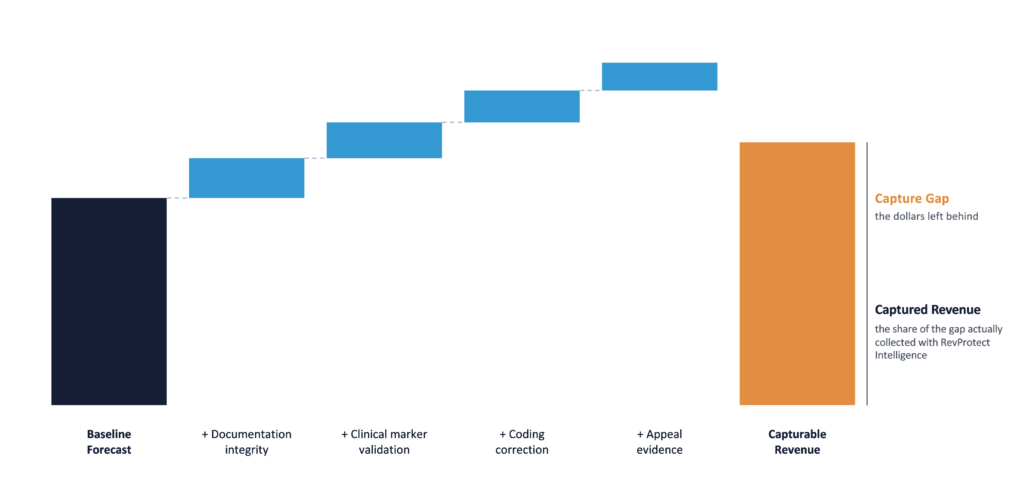
The capture gap is different from most revenue cycle problems in that it doesn’t resolve. It doesn’t age out, it doesn’t get solved by one good quarter, and it doesn’t shrink when your team works harder. Payers adapt as fast as you improve, so the machinery that creates the gap is permanent, and probably growing.
But permanent doesn’t mean unrecoverable. The gap isn’t a fixed hole in your revenue, it’s a flow. New dollars enter it every month, and each one goes one of two ways. It gets captured, prevented before the bill or recovered after, or it gets written off, as the cost of doing business with payers who automated faster than you did. The source never closes. What you capture from it is entirely up to you.
None of the mechanics (the pre-bill flags, the scored workqueue) matter until you can see your own capture gap number, broken into the specific payer patterns driving it. That’s the first thing Sift’s RevProtect platform builds for our health system clients, because everything downstream is guesswork without it.